Throughput#
Measured on macOS arm64 (M-series CPU), single-thread JAX, 100 warm calls per benchmark (cold runs discarded). Each call uses freshly randomised parameters so the JAX cache reuses the compiled traces but the inputs differ.
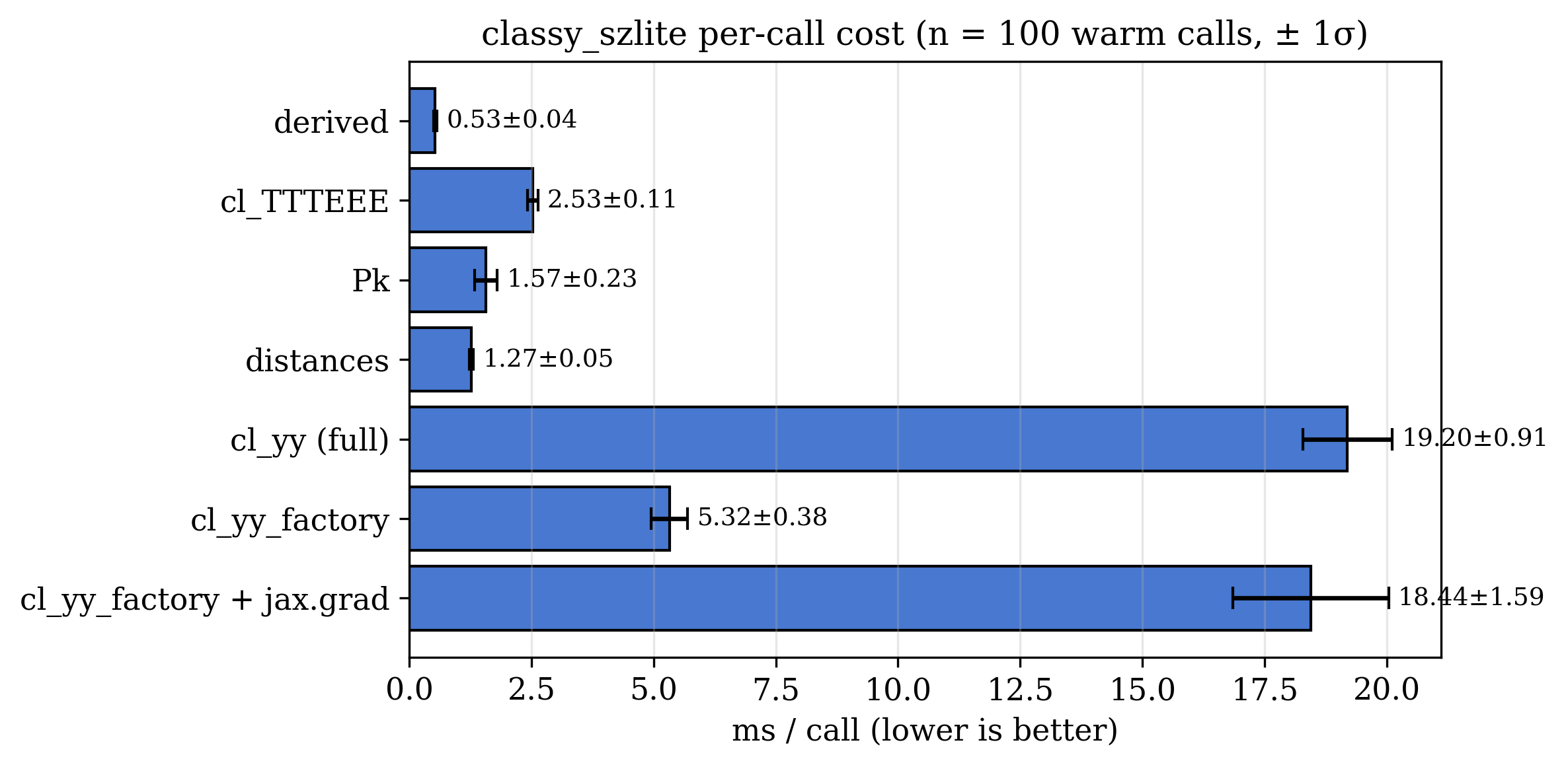
Function |
mean ± std (ms/call) |
throughput (calls/s) |
|---|---|---|
|
0.54 ± 0.04 |
1850 ± 150 |
|
2.52 ± 0.14 |
400 ± 25 |
|
1.49 ± 0.12 |
670 ± 55 |
|
1.29 ± 0.09 |
770 ± 60 |
|
17.84 ± 0.58 |
56 ± 2 |
|
5.38 ± 0.42 |
185 ± 15 |
|
17.12 ± 1.01 |
58 ± 3 |
Notes:
All numbers are after JAX warmup (cold first-call cost is ~1 s for the full Cl^yy pipeline; the factory’s first call is ~5 ms after the one-time cosmology + halo-grid setup).
For an MCMC sampling profile parameters at fixed cosmology, prefer
cl_yy_factory— it skips the emulator + halo-grid rebuild that the fullcl_yyredoes every call.Throughputs scale with the size of the ell array. Numbers above use 8 bandpower ells (ACT-DR6-style). Larger ell arrays cost proportionally more for the Cl^yy integration but the same for the emulator + halo-grid setup.
Reproduce#
import time, numpy as np
import jax.numpy as jnp
import classy_szlite as csl

cosmo = csl.CosmoParams()
ell = jnp.geomspace(1000, 6000, 8)
ev  = csl.cl_yy_factory(cosmo, ell)
rng = np.random.default_rng(0)

def bench(fn, n=100, skip=3):
    times = []
    for i in range(n + skip):
        t0 = time.perf_counter()
        out = fn()
        for o in (out if isinstance(out, tuple) else (out,)):
            if hasattr(o, "block_until_ready"):
                o.block_until_ready()
        if i >= skip:
            times.append((time.perf_counter() - t0) * 1e3)
    a = np.asarray(times)
    return a.mean(), a.std()

def call():
    P0 = float(rng.uniform(1, 12))
    beta = float(rng.uniform(3, 7))
    return ev(csl.ProfileParamsA10(P0=P0, beta=beta, B=1.25))

m, s = bench(call)
print(f"cl_yy_factory: {m:.2f} ± {s:.2f} ms/call  ({1e3/m:.0f} calls/s)")